
Aim for 1 to 3 parts per million of free chlorine, and hold the higher end of that range when stabilizer runs high. The dose to get there depends on your gallons and the form of chlorine you use.
Work out your gallons first
Labels give doses per 10,000 gallons, so a guessed volume throws every dose off by the same margin. For a rectangle, multiply length by width by average depth, then by 7.5. For a round pool, multiply diameter by diameter by average depth, then by 5.9.
A 16 by 32 pool at five feet average holds about 19,000 gallons.
The doses
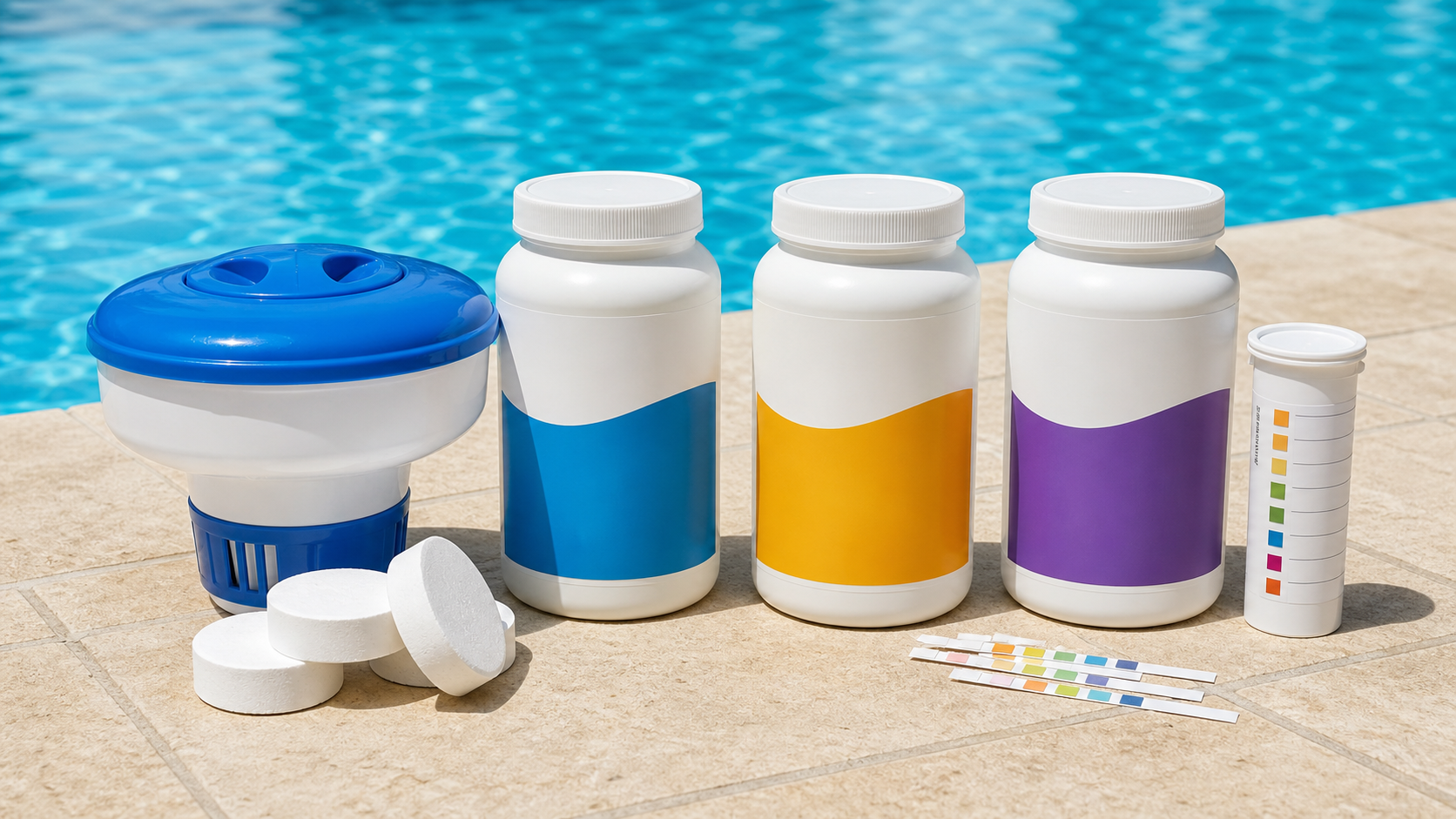
Ten percent liquid chlorine takes about 13 fluid ounces per 10,000 gallons to raise free chlorine 1 ppm, so a 2 ppm lift is about 26 ounces, a little under a quart. At 12.5% strength it is about 10 ounces per ppm.
Cal hypo granules at 65% take about 2 ounces per ppm, so about 4 ounces per 10,000 gallons for a 2 ppm lift. Dichlor takes about 2.4 ounces per ppm.
For our 19,000 gallon example, a 2 ppm lift is about 49 ounces of 10% liquid. Add about half of what you work out, wait four hours and retest.
A 15,000 gallon pool reading 1 ppm that you want at 3 needs a 2 ppm lift, which works out to about 39 ounces of 10% liquid, about 30 ounces of 12.5% liquid, or about 6 ounces of cal hypo. The math is the per-10,000 dose, times 1.5 for the gallons, times 2 for the ppm.
Tablets, liquid, or granules
Tablets melt slowly and need little attention, but every tablet adds stabilizer. Stabilizer only leaves the water through splash-out, backwashing, rain overflow and draining. Sun, filtering and evaporation leave it behind, so a pool on tablets alone climbs past 80 ppm over a season or two.
Liquid chlorine adds only chlorine and a little salt, which makes it the cleanest choice for a pool that already has enough stabilizer. Granules sit in between: cal hypo adds calcium, and dichlor adds stabilizer.
Where to put it
Tablets go in a floater or an inline feeder. In the skimmer they dissolve into acidic water that runs straight through the pump and heater and corrodes both.
Pour liquid slowly around the deep end with the pump running. Dissolve granules in a bucket of water first, because dry granules sitting on plaster bleach a white mark for good.
Storing chlorine safely
Liquid chlorine loses strength as it sits, and it loses it faster in heat, so a jug that spent August in a hot garage doses weaker than its label says. Buy what you will use in a few weeks, keep the cap tight and store it in the shade.
Keep cal hypo and tablets dry and on separate shelves, and keep both away from acid. Cal hypo mixed with trichlor tablets or with acid can start a fire or release chlorine gas, so use a clean, dry scoop for each product and never pour one chemical into a bucket that held another.
Why it disappears every afternoon
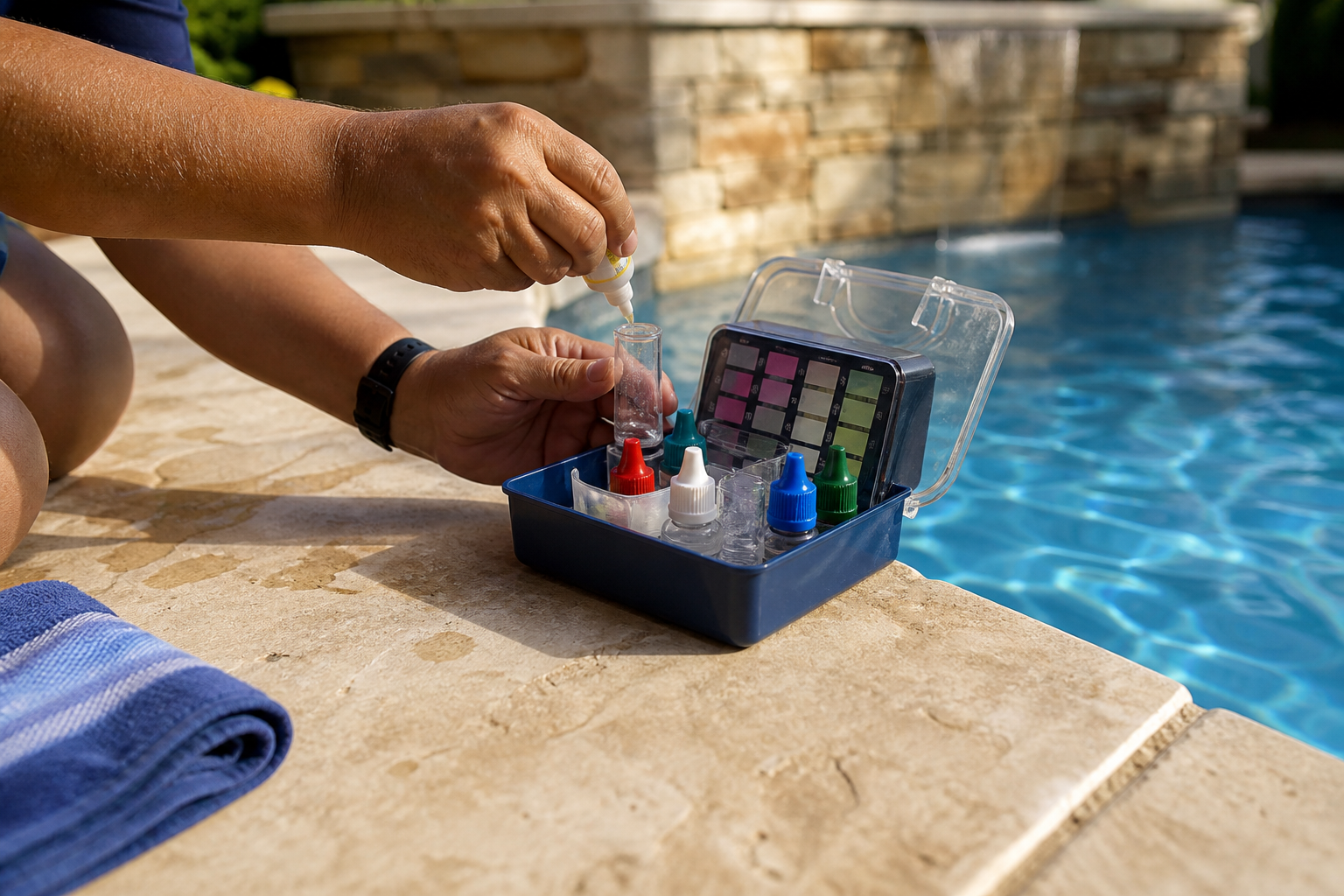
In water with no stabilizer, strong sun can burn off about half the chlorine in under an hour. Stabilizer (cyanuric acid) shields it, and at 30 to 50 ppm the loss is far slower.
Below 30 ppm stabilizer a midday dose can be gone by mid afternoon. Above about 80 chlorine works noticeably slower, and above 100 the practical fix is draining part of the pool and refilling. Salt pools run 60 to 80. The rest of the targets are in what pool chemicals you actually need.
High pH weakens chlorine too, which is why lowering pH to 7.4 to 7.6 often helps more than another dose. Algae burns through chlorine faster than anything else, and the causes are in what causes algae in a pool.
If chlorine will not hold overnight
Test free chlorine at dusk, keep the pool closed overnight, and test again before sunrise. With the sun out of the picture, a pool in good shape loses no more than about 1 ppm overnight. A bigger drop means something in the water is using chlorine up, usually algae too early to see, and the fix is to raise chlorine to shock level and hold it there; the doses are in how to shock a pool.
Summer storms are the other overnight thief. A few inches of rain dilutes chlorine and washes in leaves and pollen that consume what is left, so test the morning after any storm that raised the water level. When the pool overflows, stabilizer goes out with the water, so a long wet spell can leave it below 30 and chlorine burning off faster than before.
We will do the math
Bring a pint of pool water, your pool’s length, width and depths, and the chlorine you use now to the supply store on Navarro. We will test it and write your dose in ounces.
Frequently Asked Questions
How much liquid chlorine should I add to my pool?
About 13 fluid ounces of 10% liquid chlorine per 10,000 gallons raises free chlorine 1 ppm, so 2 ppm takes about 26 ounces. Add half your calculated dose first, then retest after four hours.
What should my free chlorine level be?
Between 1 and 3 parts per million, or 1 to 4 for many salt pools. Below 1, algae gets a foothold. Above about 5, swimmers get irritated eyes and swimsuits fade.
How many chlorine tablets do I need?
It depends on the brand, the water temperature and your gallons, so start from the bucket label and adjust by your weekly test. Use a floater or inline feeder, and keep tablets out of the skimmer.
Why does my chlorine disappear so fast?
Usually low stabilizer. In unstabilized water strong sun can burn off half the chlorine in under an hour. High pH and an early algae bloom both use it up quickly too.
Can I add too much chlorine to a pool?
Yes. Past about 5 parts per million swimmers get sore eyes and swimsuits fade. Very high levels also bleach vinyl liners.
Is liquid chlorine better than tablets?
For a pool that already has enough stabilizer, yes, because liquid adds only chlorine and a little salt. Tablets add stabilizer with every dose, and it stays until water is splashed out, backwashed, overflowed or drained.
How often should I add chlorine to my pool?
With liquid chlorine, most pools need a dose every day or two in summer and every few days in winter, guided by your test. Tablets in a feeder and salt cells add chlorine continuously, so test two or three times a week and adjust the feeder or cell output.
