
High pH is the reading we correct most often at our counter, and on most pools a measured dose of muriatic acid brings it back the same afternoon. Above 7.8 your chlorine loses most of its bite, the water turns dull, scale starts forming on the tile and swimmers come out with itchy eyes.
Test before you pour
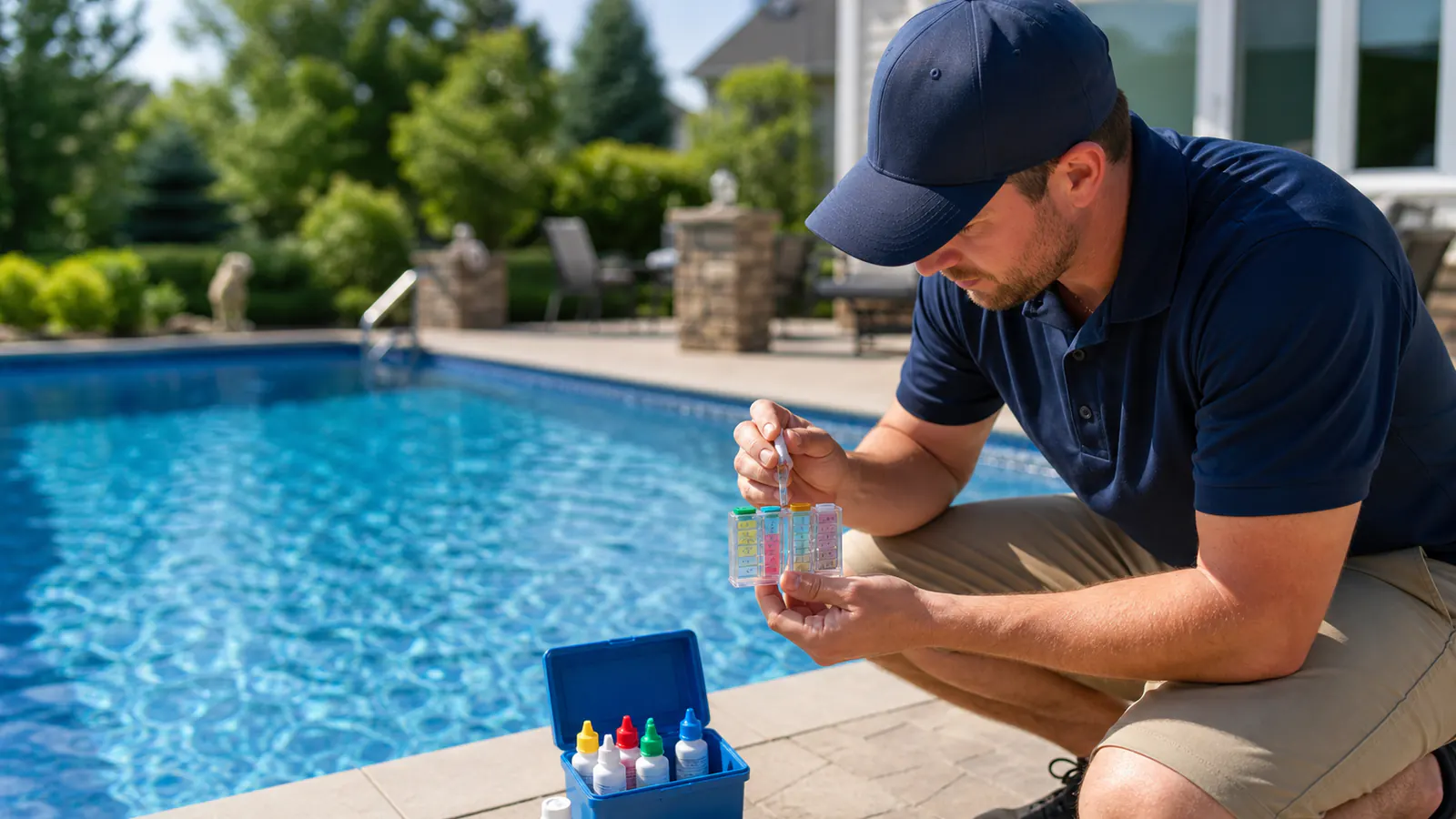
Take the sample from the deep end, elbow deep and away from the returns. Write down pH and total alkalinity together, because acid moves both, and the full sampling method is in how to test pool water.
The targets are pH 7.4 to 7.6 and alkalinity 80 to 120 ppm.
Muriatic acid or dry acid
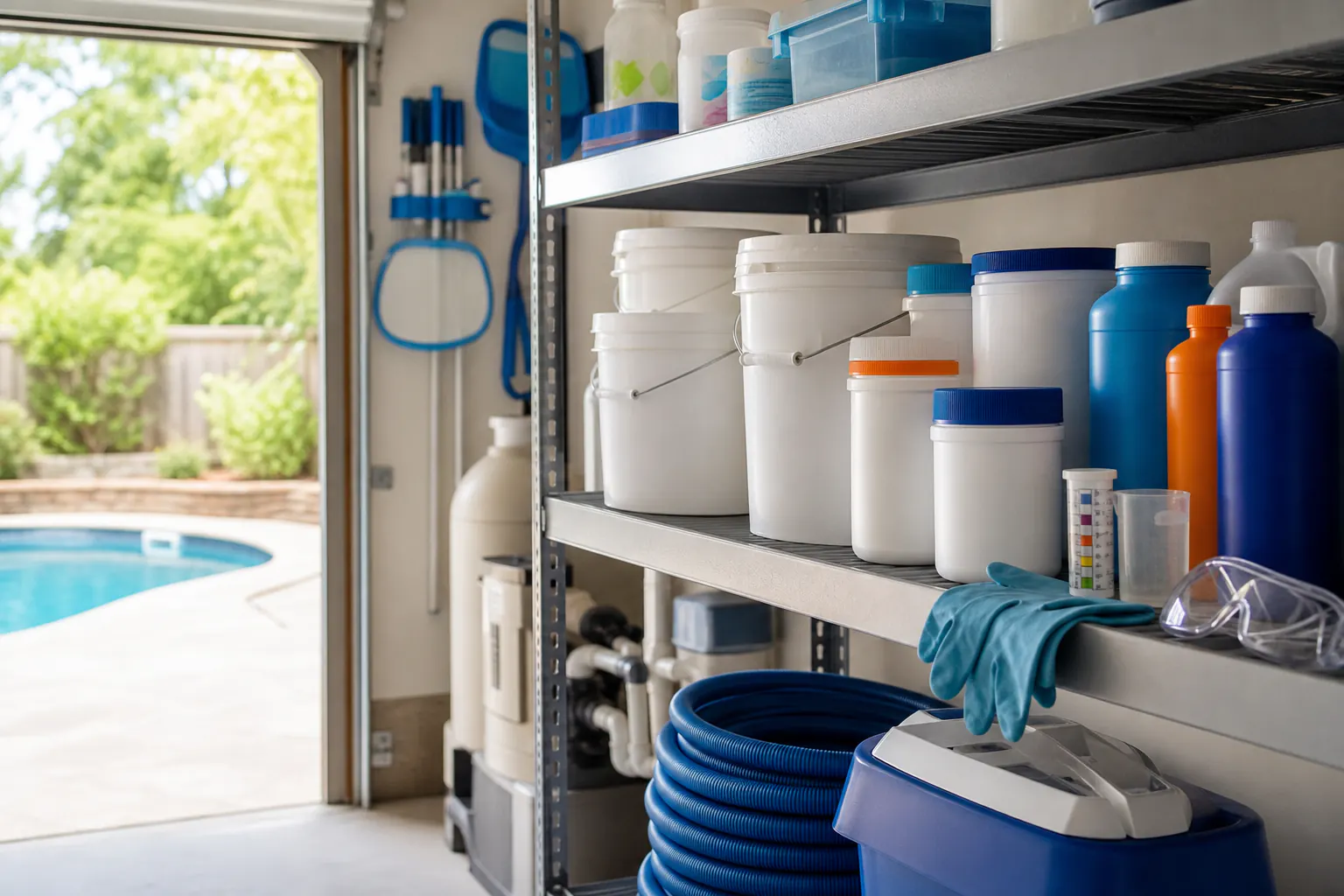
Muriatic acid is the cheap, fast option, but it fumes and burns skin, so open it outdoors with goggles on. Dry acid (sodium bisulfate) comes as granules that are easier to carry and store, though it costs more per dose and slowly builds sulfates in the water.
For most backyard pools we use muriatic. Buy pool grade, around 31 percent, and leave the concrete-cleaning grade at the hardware store.
How much to add
Start small, since acid is easy to add and slow to undo. On a 10,000 gallon pool, about 12 to 16 fl oz of 31.45 percent muriatic acid lowers pH by roughly 0.2 when alkalinity is near 100. On a 15,000 gallon pool that becomes about 18 to 24 fl oz.
Check the strength on your bottle, add part of the dose, and retest before adding the rest. Higher alkalinity means more acid for the same drop.
Say a 20,000 gallon pool reads pH 8.0 with alkalinity at 100, and you want 7.5. That is a drop of 0.5, or two and a half steps of 0.2. Each step takes 24 to 32 fl oz on 20,000 gallons, so the full dose lands around 60 to 80 fl oz. Pour one quart, run the pump four to six hours, retest, and add the rest only if the reading still calls for it.
Keep acid and chlorine apart until each has mixed in. Never combine them in a bucket, a feeder or the same spot in the pool, because concentrated acid and chlorine together release chlorine gas. Add one, run the pump a few hours, then add the other.
Where to pour it
Turn the pump on first so moving water carries the acid through the pool. Then walk to the deep end and pour slowly into the water in front of a return jet, keeping it away from the skimmer, the walls and the steps, since acid sitting on plaster can etch a light spot into it.
Wear goggles and gloves, stand upwind and keep your face away from the bottle. Wait four to six hours with the pump running, then retest.
If the reading will not move
Check the test before you add more acid. The phenol red reagent in most kits turns purple and reads falsely high when free chlorine is above about 10 ppm, so a pH test taken the morning after a shock can show 8.2 when the water is fine. Most drop kits also top out at 8.2, so a reading at the top of the scale can mean 8.4 or higher, and the dose needs to be bigger than the chart suggests. Wait for chlorine to fall back near 3 ppm and test again.
Aeration pushes pH up while you are trying to bring it down. Turn off waterfalls, spa spillovers and fountains, and aim the return jets down, until the reading holds.
Why it keeps coming back
If you drop pH on Monday and it is high again by Friday, alkalinity is usually the reason. With alkalinity above 120, pH climbs back after every dose, and you end up adding acid twice a week all summer. Bring alkalinity into range with the acid-and-aerate method in how to lower alkalinity in a pool, and pH starts holding on its own.
Salt pools drift up on their own, because the gas bubbling through the cell drives carbon dioxide out of the water; we explain that in salt water vs chlorine pools in Texas. Fresh plaster also pushes pH up for most of its first year, and new fill water and heavy rain move it too.
Stop at 7.4
High pH on top of Victoria’s hard tap water is what lays the white crust on tile and inside heaters and salt cells. Holding pH at 7.4 to 7.6 keeps calcium dissolved, and our post on calcium hardness in pool water covers the other half of that balance.
Below 7.2 the water turns aggressive and starts pulling calcium out of the plaster and corroding the copper in a gas heater. If you overshoot, the fix is in how to raise pH in pool water.
Bring about a pint of water to the store for free water testing, along with your pool’s gallons and the strength printed on your acid bottle, and we will work out the dose. Call (361) 575-5821 with questions.
Frequently Asked Questions
What lowers pH in a pool?
Muriatic acid or dry acid, also sold as sodium bisulfate. Muriatic is cheaper and faster. Dry acid is easier to handle but adds sulfates over time.
How much muriatic acid do I need to lower pH?
On 10,000 gallons, about 12 to 16 fl oz of 31.45 percent acid lowers pH roughly 0.2 at alkalinity near 100, so about 18 to 24 fl oz on 15,000 gallons. Add part of it, run the pump four hours and retest.
How long after adding acid can I swim?
Once the pump has run four to six hours and pH tests between 7.4 and 7.6. Swimming sooner risks a pocket of acid that has yet to mix in.
Why does my pool pH keep rising?
High total alkalinity is the usual cause, because it pushes pH back up after every dose of acid. Salt pools, fresh plaster and new fill water all push pH up too.
Can I add acid and chlorine at the same time?
Never mix them in a bucket, a feeder or the same spot in the pool. Concentrated acid and chlorine together release chlorine gas, so add one, run the pump a few hours, then add the other.
Does baking soda lower pH in a pool?
Baking soda raises alkalinity and nudges pH up slightly, so it works against you here. Use muriatic acid or dry acid to bring pH down, and save baking soda for low alkalinity.
What happens if pool pH is too low?
Below 7.2 the water starts pulling calcium out of plaster and grout and corroding the copper inside a gas heater. It also stings eyes and corrodes metal fittings.
