
Most pool stains come out with the water still in the pool. Owners drain anyway when they treat the wrong kind of stain, because stains are either metal or organic and the two treatments work against each other, so test before you buy anything.
Find out which stain you have
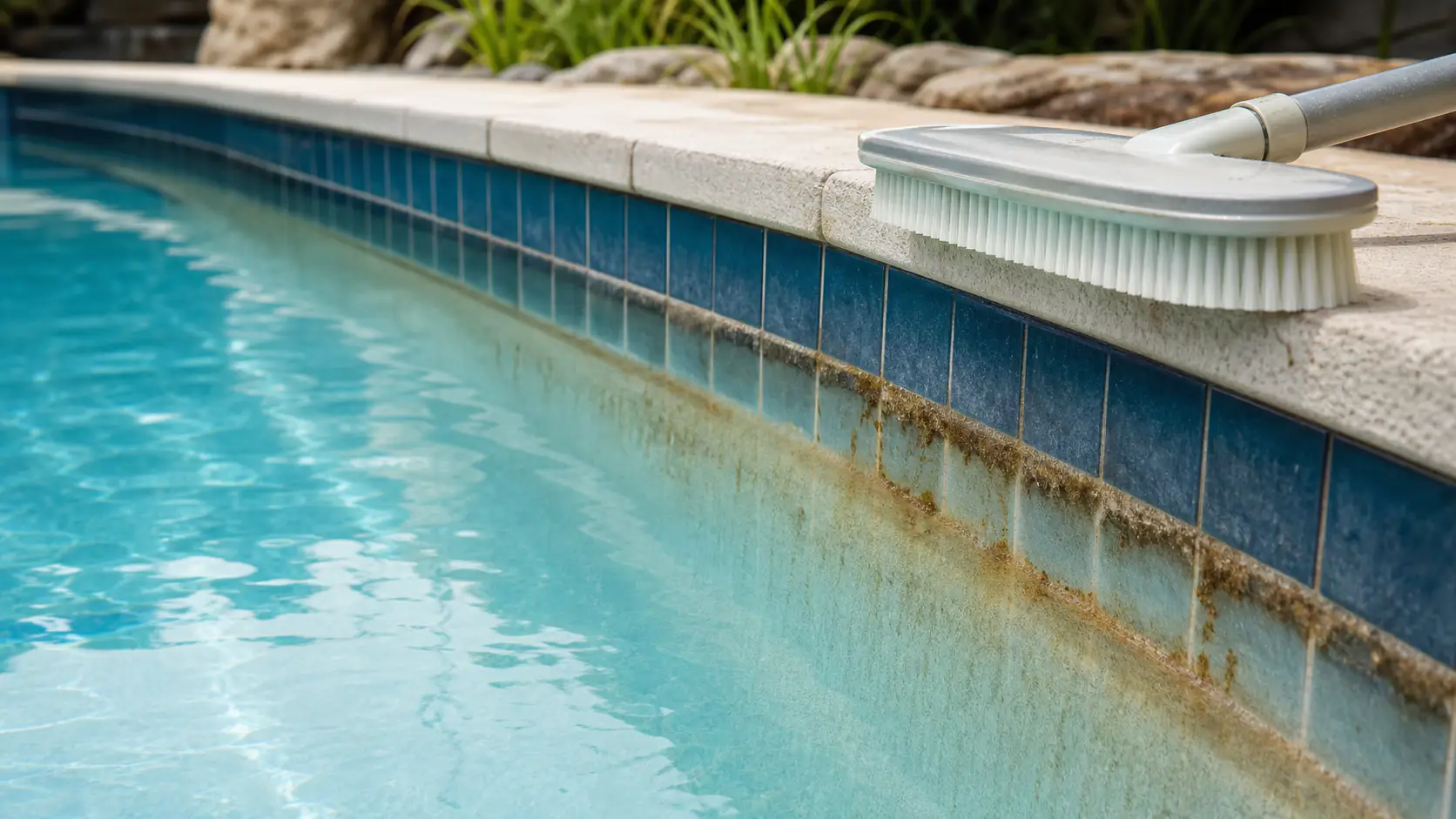
Hold a vitamin C tablet against the stain for thirty seconds. If the spot lightens, the stain is metal: iron, copper or manganese that came in with the fill water or off corroded parts.
If the vitamin C does nothing, hold a chlorine tablet on the same spot. A stain that lightens under chlorine is organic, left behind by leaves, algae, worms or berries.
Color gives you a head start. Brown and rust usually mean iron, blue-green means copper, and purple or black often points to manganese. Leaf shapes and dark blotches are organic.
Organic stains are the easy ones
Brush the spot hard, then raise free chlorine to about 10 ppm and hold it there for a day. Most leaf and algae marks lift with that alone, and an enzyme product helps on stubborn ones.
For a 15,000-gallon pool sitting at 2 ppm, getting to 10 ppm takes about 1.2 gallons of 10% liquid chlorine, or about 1.5 lb of cal hypo. Add it at dusk so the sun does not burn it off before it works, and retest in the morning, since the stain itself uses up some chlorine overnight.
Around Victoria the organic stains follow the trees. Live oaks drop their old leaves in late winter and spring, and wet leaves left on the floor for a few days print brown outlines into plaster. Pecan husks in fall leave darker, inky spots. Skimming before the leaves sink saves you the stain treatment.
Keep pH at 7.4 to 7.6 while you work, because chlorine slows down as pH climbs above that range. If yours is reading high, our post on how to lower pH in a pool walks through bringing it down with acid.
Metal stains need the opposite approach
Keep shock away from a metal stain, since chlorine sets it harder. Let free chlorine drop close to zero first, then spread an ascorbic acid product evenly over the water and brush.
Metal stains often lift within minutes, but the metal is still in the water, so add a metal sequestrant right away or it settles back onto the plaster within days.
Then raise chlorine about 1 ppm a day until you are back at 2 to 3 ppm. A fast jump pushes the metal back onto the wall.
Ascorbic acid is an acid, so a full-pool treatment pulls pH and alkalinity down along with the stain. Retest both once the stain is gone and bring them back to 7.4 to 7.6 and 80 to 120 before you start raising chlorine. Run the pump around the clock during the treatment so the product reaches every wall.
A single small spot can be treated alone. Pour a cup of granular ascorbic acid into an old sock, tie it off, and hold it on the stain with the pole for a few minutes. If the spot fades, you have your answer and a fix for that patch, and the metal it released still needs a sequestrant.
Where the metal came from
Well water is the usual source around Victoria, and iron rides in every time you top the pool off from a well. If that is your fill water, dose a sequestrant monthly.
Copper comes from a corroding heater, a copper-based algaecide, or low pH eating the equipment. If your pH runs below 7.4, our guide on how to raise pH in pool water covers the soda ash doses, and the rest of the targets are in our guide to the pool chemicals you need. Fix the source and you are spared a repeat next summer.
If the stain will not lift
A stain that ignores both tablets is often covered by a thin layer of calcium scale, which keeps any treatment from reaching it. Scrub the spot with a pumice stone on tile or a stainless brush on plaster to break the crust, then repeat the tablet test. Some stains are mixed, with metal under organic, and need the organic treatment first, a few days for chlorine to drop, then the metal treatment.
What will not come out this way
Stains under the plaster, rather than on it, stay put, and so does deep staining from a pool that sat neglected for years. Those are the cases for an acid wash, and its costs and risks are in how to acid wash a pool.
White crust on the tile line is calcium scale, a separate job covered in how to clean calcium off pool tile.
Bring us the stain
If the tablet test leaves you unsure, take a close photo of the stain in daylight and bring it to our pool supply store with about a pint of water drawn from elbow depth. Tell us whether you fill from a well.
We will test for metals and hand you the product that matches the stain. Questions before you come in go to (361) 575-5821.
Frequently Asked Questions
How do I know if a pool stain is metal or organic?
Hold a vitamin C tablet on it for thirty seconds. If it lightens, it is metal. If it stays the same, try a chlorine tablet; if that lightens it, the stain is organic.
Can pool stains be removed without draining?
Most can. Organic stains lift with brushing and high chlorine. Metal stains come out with ascorbic acid in a full pool, followed by a sequestrant to hold the metal in the water.
Why did my stain come back after I removed it?
The metal is still in the water after treatment. Without a sequestrant, or if chlorine climbs faster than about 1 ppm a day, it settles onto the plaster again within days.
Will shocking the pool remove stains?
It removes organic stains and makes metal stains worse. Shocking a metal stain drives it deeper into the plaster, so identify the stain before you add anything.
What causes rust colored stains in a pool?
Iron, usually from well fill water, sometimes from a corroding fitting or rebar. Monthly sequestrant is the standard defense if you fill from a well.
When does a stained pool actually need draining?
When the stain sits under the plaster rather than on it, or when a pool has been neglected for years. Everything short of that should be tried in a full pool first.
