
Most bad test results come from a bad sample. Water scooped off the top next to a return jet reads nothing like the rest of the pool, so fix how you draw the sample first and half your chemistry problems get easier.
Take the sample right
Go to the deep end, away from the skimmer and the returns. Turn the bottle upside down, push it elbow deep, then flip it and let it fill, so you get water from about eighteen inches down.
Test within a few minutes. An hour in a hot truck burns off chlorine and shifts pH, so a sample headed to the store should reach us within the hour.
Wait a few hours after adding chemicals, with the pump running, before you test again. Until the dose mixes through, the reading tells you about one corner of the pool.
How often to test
Check chlorine and pH twice a week in summer and once a week in winter. Alkalinity and stabilizer need a monthly check, and calcium hardness a few times a year.
Test after every heavy rain, after a pool party and after you top the pool off with the hose. Storm water changes everything at once, which is why our hurricane pool prep guide puts testing first on the cleanup list.
Strips, kits, and drop tests
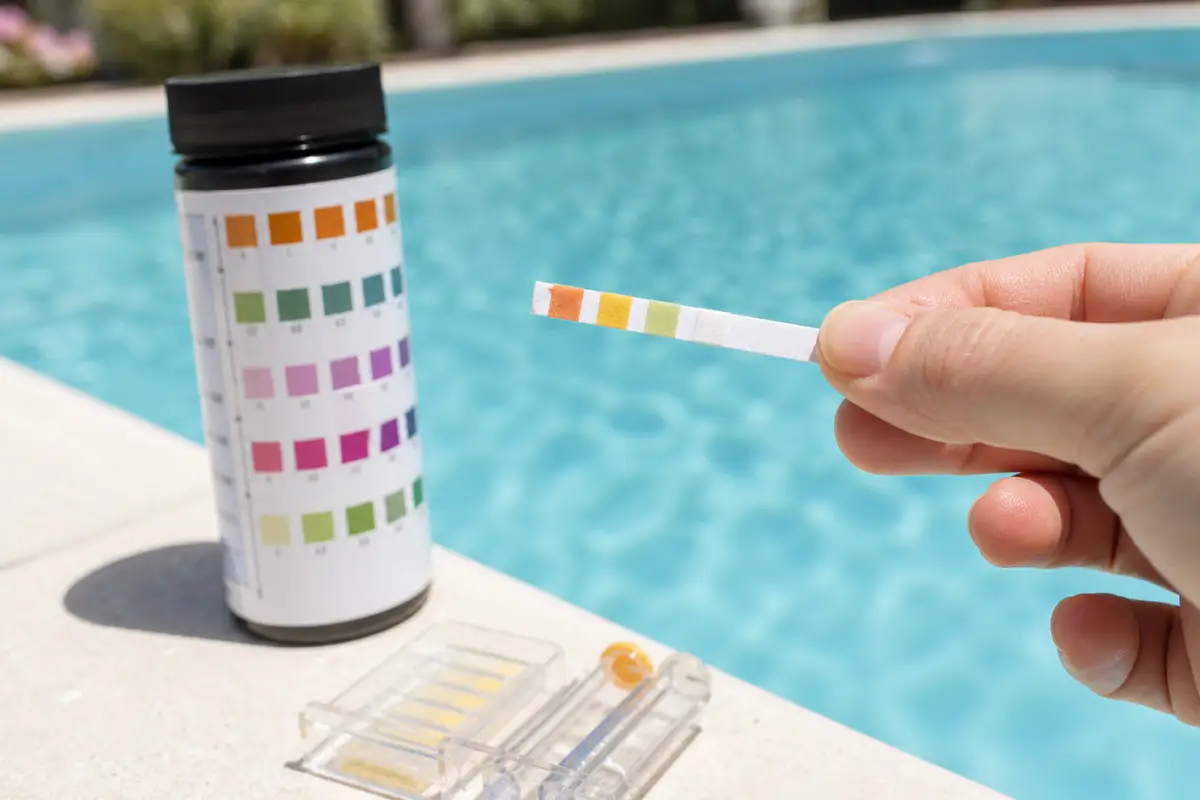
Strips are fast and fine for a routine check. Dip once, hold the strip level and still, and read it at the time printed on the bottle. They lose accuracy once the bottle has been open a while, so keep the cap tight and replace them after a year.
A drop test gives you a counted number in place of a color match. You add reagent one drop at a time until the sample changes color, and the drop count is the reading.
Chlorine has one catch. Strips and standard DPD kits both bleach out and read falsely low when chlorine is very high, as it is after a shock. An FAS-DPD drop kit reads high chlorine correctly, which makes it the kit to own if you ever clear algae yourself.
Free chlorine and total chlorine
Free chlorine is the part still available to kill bacteria and algae. Total chlorine adds the combined chlorine that has already reacted with sweat and sunscreen. When total runs about 0.5 ppm above free, the pool smells strongly of chlorine, eyes sting, and it needs a shock even with free chlorine inside the target.
What the numbers should be
Free chlorine sits at 1 to 3 parts per million day to day, and pH at 7.4 to 7.6. Total alkalinity runs 80 to 120 ppm. Calcium hardness runs 200 to 400 ppm for plaster, and the trouble at both ends is covered in our guide to calcium hardness in pool water. Stabilizer belongs between 30 and 50 ppm for a chlorine pool and 60 to 80 for salt.
Adjust them in order: alkalinity first, then pH, then chlorine. Our post on how to raise pH in pool water explains why that order matters.
Say a 20,000 gallon pool tests at 70 ppm alkalinity and 0.5 ppm free chlorine. Baking soda raises alkalinity about 10 ppm per 1.5 lb in 10,000 gallons, so this pool needs about 3 lb for every 10 ppm, or roughly 9 lb to reach 100. Add it in three 3 lb doses with the pump running and retest between them. Raising its chlorine 2 ppm with 10% liquid, at about 13 fl oz per ppm per 10,000 gallons, takes about 52 fl oz.
The test most people skip
Few owners test stabilizer, and it is the number behind most of the “good chlorine, green pool” calls we get in August. Every trichlor tablet in your floater or feeder adds more of it. Sun, filtering and evaporation leave it in the water, and shocking leaves it there too; only splash-out, backwashing, rain overflow and draining take it out.
Above about 80 ppm, chlorine works noticeably slower, so the test shows a normal number while algae gets a head start. That is one reason for cloudy water that no dose fixes. Once stabilizer passes 100, the way out is dilution: drain part of the pool and refill with fresh water.
When the readings make no sense
If a strip and a drop kit disagree, trust the drop kit. Reagents age fast in a hot shed or truck, so store the kit indoors and replace reagents every season. A pH that drifts back within a day usually means low alkalinity. A chlorine test that turns clear or pale right after a heavy shock is bleach-out, and the FAS-DPD kit gives the true number before you add any more.
Bring us a sample
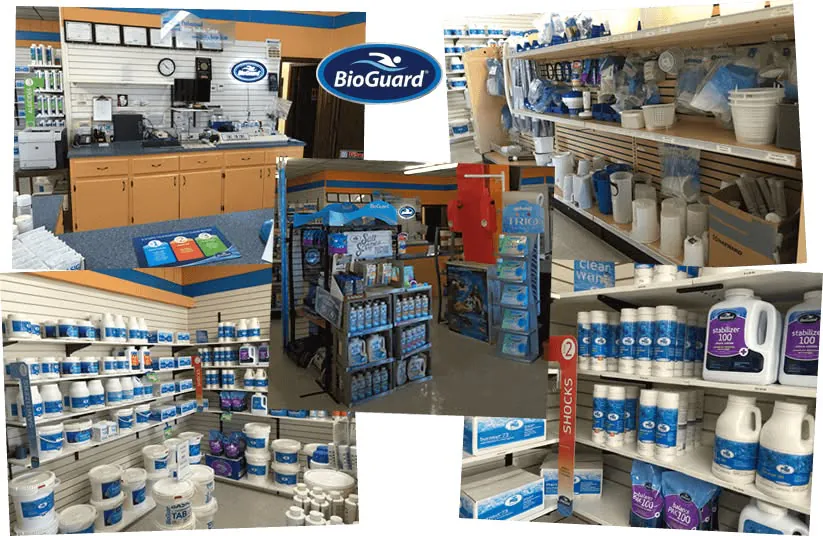
We run free water testing at our pool supply store at 4801 N Navarro St. The BioGuard Spin Lab reads the full panel in a few minutes, and we tell you what to add and how much.
Bring about a pint of water drawn from elbow depth, away from the returns and skimmer, within an hour of filling the bottle. If you use tablets or a salt system, tell us, since it changes the stabilizer target. Call (361) 575-5821 if you want to check our hours first.
Frequently Asked Questions
How often should I test my pool water?
Chlorine and pH twice a week in summer, once a week in winter. Alkalinity and stabilizer monthly, calcium hardness a few times a year. Always test after heavy rain or a big swim day.
Where should I take a pool water sample from?
The deep end, elbow deep, away from the skimmer and the return jets. Water at the surface or near a return has just been treated and will give a misleading reading.
Are pool test strips accurate?
They are close enough for a routine check, but they read by color and lose accuracy as the bottle ages. They also read low at very high chlorine. For any real decision, use a drop test or bring a sample in.
What should my pool numbers be?
Free chlorine 1 to 3 ppm, pH 7.4 to 7.6, total alkalinity 80 to 120, calcium hardness 200 to 400 for plaster, and stabilizer 30 to 50 for chlorine pools or 60 to 80 for salt.
Why is my chlorine reading fine but the pool still turns green?
High stabilizer is the usual answer. Above about 80 ppm chlorine works noticeably slower, even though the test shows a normal level. Past 100, draining and refilling part of the pool is the fix.
Do you test pool water for free?
Yes. Bring about a pint of water from elbow depth to our supply store at 4801 N Navarro St. We run it through the BioGuard Spin Lab at no charge and tell you exactly what to add.
