
Calcium hardness belongs at 200 to 400 parts per million in a plaster pool, and vinyl and fiberglass pools run fine at 150 to 250. Fill water around Victoria runs hard, so most local pools drift toward the top of that range or past it, where calcium starts scaling heaters and salt cells long before it shows on the tile.
What it measures
Calcium hardness is how much dissolved calcium is in the water. Water short on calcium draws it out of whatever it touches, and water carrying too much drops it as scale, so the target range is the band where plaster and equipment both stay intact.
Too low, and the water eats your pool
Below 200 parts per million, plaster pool water pulls calcium out of the plaster and grout. The surface goes pitted and rough underfoot, and tile can start to loosen as the grout washes out. Low calcium also makes the water foam more easily.
Vinyl and fiberglass have no plaster to lose, which is why they are fine down to about 150. On those pools, low calcium mainly matters for exposed metal such as ladders and rails.
Calcium chloride, sold as calcium hardness increaser, raises the number directly. Dissolve it in a bucket and add it with the pump running.
It gives off heat as it dissolves, enough to make a bucket too hot to hold. Fill the bucket with pool water first, then add the product slowly while stirring, and never pour water onto a pile of dry flakes. Keep the bag sealed, because it pulls moisture from the air and turns into a solid block.
Too high, and it starts coming back out
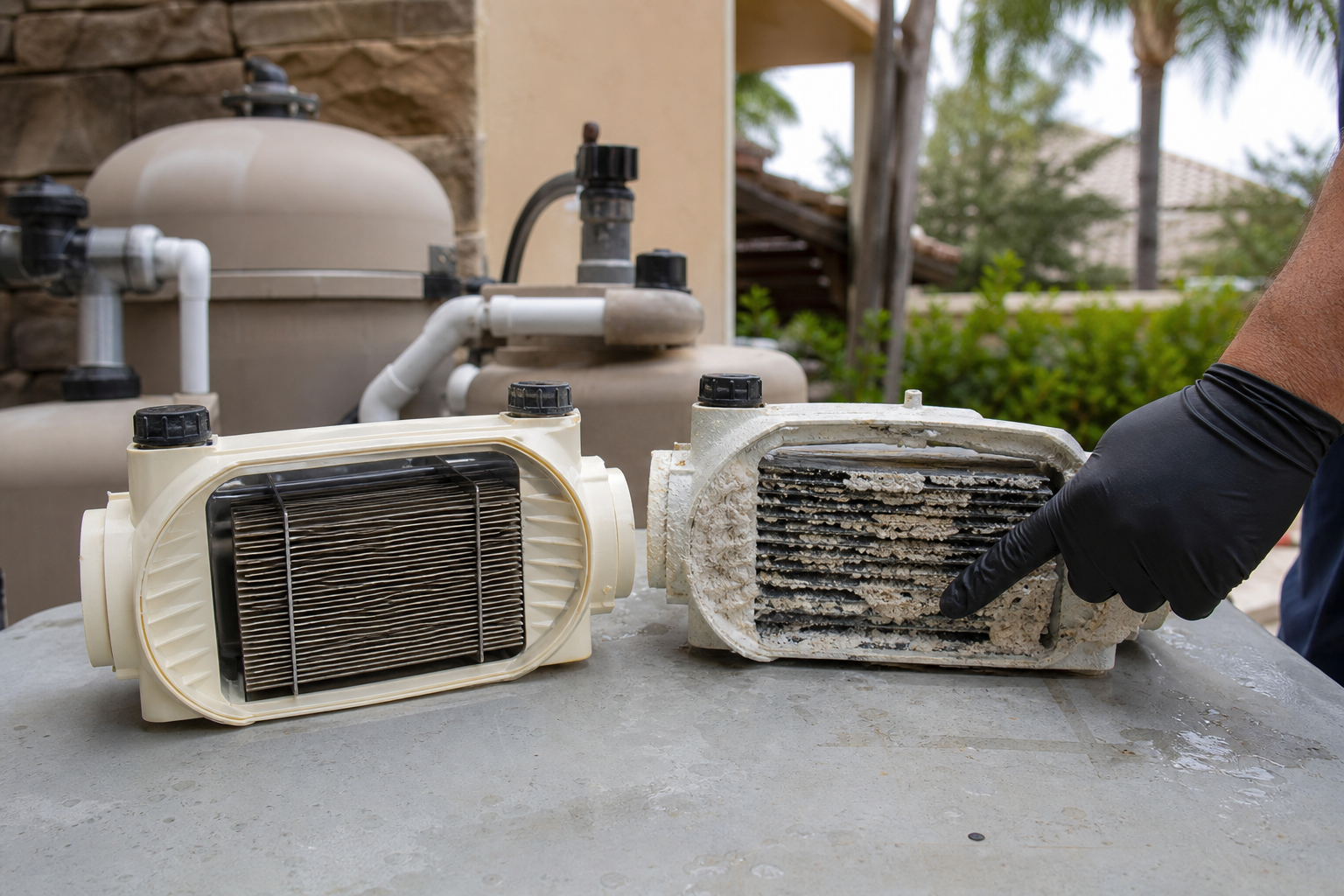
Above 400 parts per million the water cannot hold all of it, and calcium drops out as scale. You usually see it first as a white band on the tile, which we cover in cleaning calcium off pool tile.
The expensive damage happens inside the equipment. Scale coats the heat exchanger in a heater and chokes the flow, so the heater runs harder and eventually fails. The same crust cakes the plates of a salt cell and cuts its chlorine output until it stops. High calcium can also cloud the water when the other tests read fine, and it loads a filter with fine white grit.
Heat makes the problem worse. Warm water holds less calcium than cool water, so scale forms first at the hottest point in the system, the heater’s exchanger, and pools here scale fastest in August. High pH and high alkalinity push the same way, which is why a pool at 350 ppm can still scale if pH sits at 7.9.
A salt cell sees the same effect up close, since the water right at its plates runs at a higher pH than the rest of the pool. Pull the cell and look inside every few months; white flakes between the plates mean it needs cleaning and the water needs testing.
Lowering it is the hard part
No chemical removes calcium from pool water. Sequestering agents bind it so it stays dissolved instead of forming scale, which buys time, but the calcium is still in the pool and you keep dosing as the effect wears off.
The working fix is dilution: drain part of the pool and refill with softer water. How much to drain depends on the hardness of your fill water, so test the hose water before you start. Say a 15,000 gallon pool tests 600 and your hose tests 200. Replacing half the water, about 7,500 gallons, brings it to roughly 400, and taking it down in two or three partial drains keeps the shell weighted. Mobile reverse osmosis trailers can also filter calcium out without draining; ask us whether one is working in the area.
Never drain a pool all the way without knowing your groundwater situation, because an empty shell can lift out of wet ground. Vinyl pools should only be drained by a pro, since the liner can shrink or float.
Why it keeps climbing on its own
When water evaporates, its calcium stays behind, and every top-off from a hard-water hose brings in more. A pool topped off all summer gets harder month after month.
Some chemicals add to it as well. Cal hypo shock is calcium based, so a pool shocked with it all season climbs a little with every dose.
How it connects to everything else
Calcium works with pH and alkalinity as a set. High readings on all three push the water toward scale, and low readings on all three push it toward etching plaster, so adjust them together. Our rundown of what pool chemicals you need lists targets for all of them.
High calcium is also one of the five causes in why is my pool cloudy.
Test it before you guess
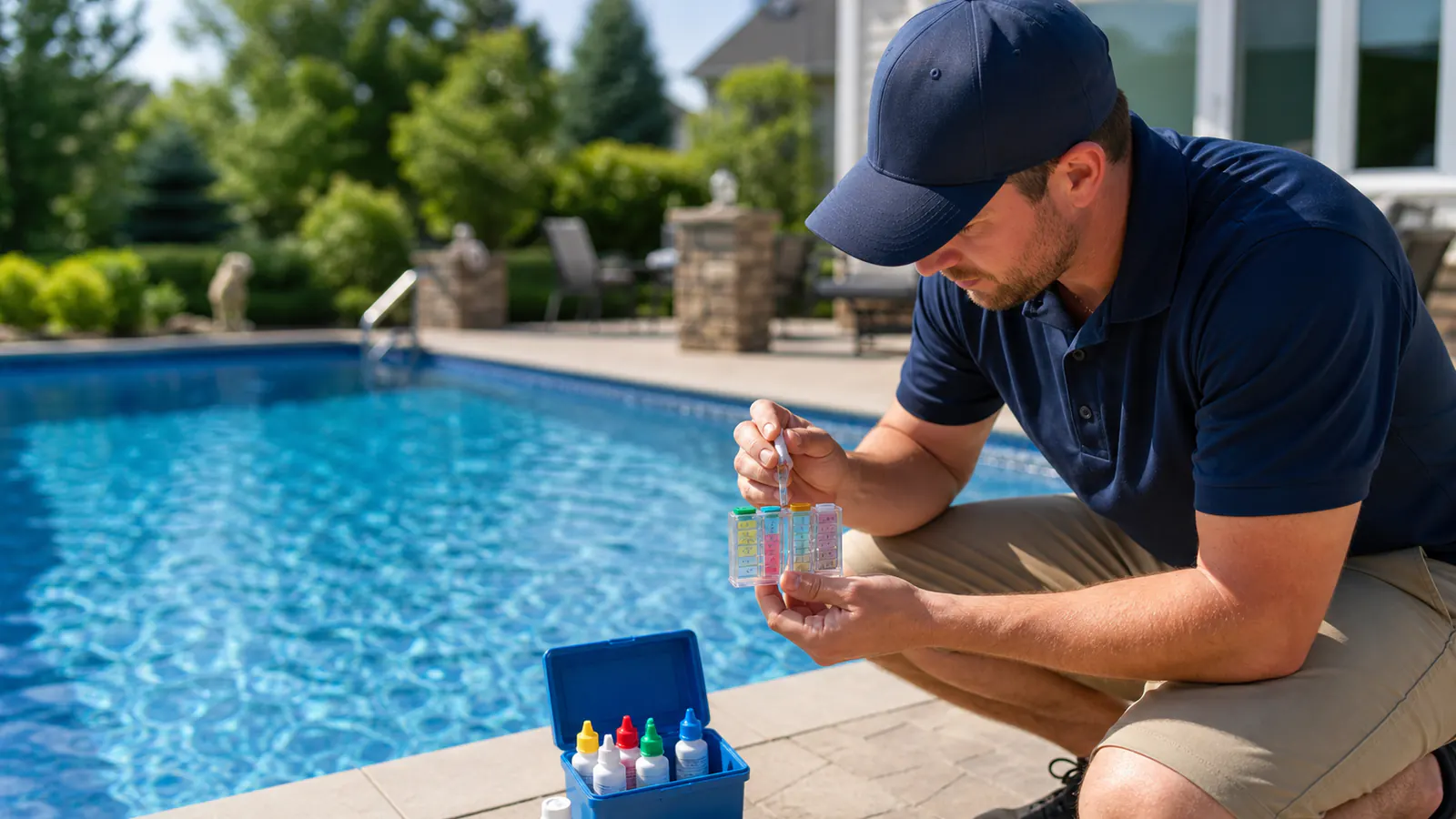
Strips give you a rough read, and a drop test gives the real number. We run the test free at the supply store.
Bring two samples: a pint of pool water from elbow depth and a pint from the hose. Those two numbers together show whether a partial drain will help, and roughly how much water has to go. Questions before you come in go to (361) 575-5821.
Frequently Asked Questions
What should calcium hardness be in a pool?
Between 200 and 400 parts per million for plaster pools, and 150 to 250 for vinyl and fiberglass. Below 200 plaster pool water starts pulling calcium out of plaster and grout. Above 400 it starts depositing scale.
How do I lower calcium hardness in a pool?
By dilution. Drain part of the pool and refill with softer water. No chemical removes calcium, and sequestering agents only hold it in solution for a while.
What happens if calcium hardness is too low?
In a plaster pool the water pulls calcium from plaster, grout and tile. Surfaces get pitted and rough, grout washes out, and the water foams more easily.
Do sequestering agents remove calcium?
They bind calcium so it stays dissolved instead of forming scale, which buys you time. The calcium is still in the pool and the effect fades, so you have to keep dosing.
Why does my calcium hardness keep rising?
Evaporation leaves calcium behind, and every top-off from a hard water hose adds more. Cal hypo shock adds calcium too.
Does calcium hardness affect a salt cell?
Yes. Scale cakes onto the cell plates and cuts chlorine production, then eventually stops it. It does the same thing inside a heater, where it chokes the heat exchanger.
Is Victoria tap water too hard for a pool?
It is hard enough that most pools here run high on calcium after a season of top-offs. Test your hose water once so you know what every refill adds.
