
If you add acid on Monday and pH is back at 8.0 by Wednesday, test total alkalinity before you buy more acid.
Alkalinity is the awkward number to bring down, because muriatic acid lowers it and lowers pH at the same time. Most owners pour, watch pH crash, and stop halfway. The fix is a slow cycle of acid and air that takes several days.
What alkalinity actually does
Total alkalinity works like a shock absorber for pH. Between 80 and 120 parts per million it holds pH steady through rain, swimmers and chlorine doses. Above 120 it turns stubborn and keeps pulling pH up toward 8.0, while below 80 pH bounces after every small change.
Fill water around Victoria is hard, so the pools we test run high far more often than low.
Signs yours is too high
The classic sign is acid that seems to stop working: you add it, pH drops, and two days later the test reads 8.0 again. Scale builds along the tile line, and the water can look slightly hazy even with good chlorine.
Chlorine also seems weak however much you add, because it works slower at high pH. More on that haze is in why your pool is cloudy.
The pour and aerate method
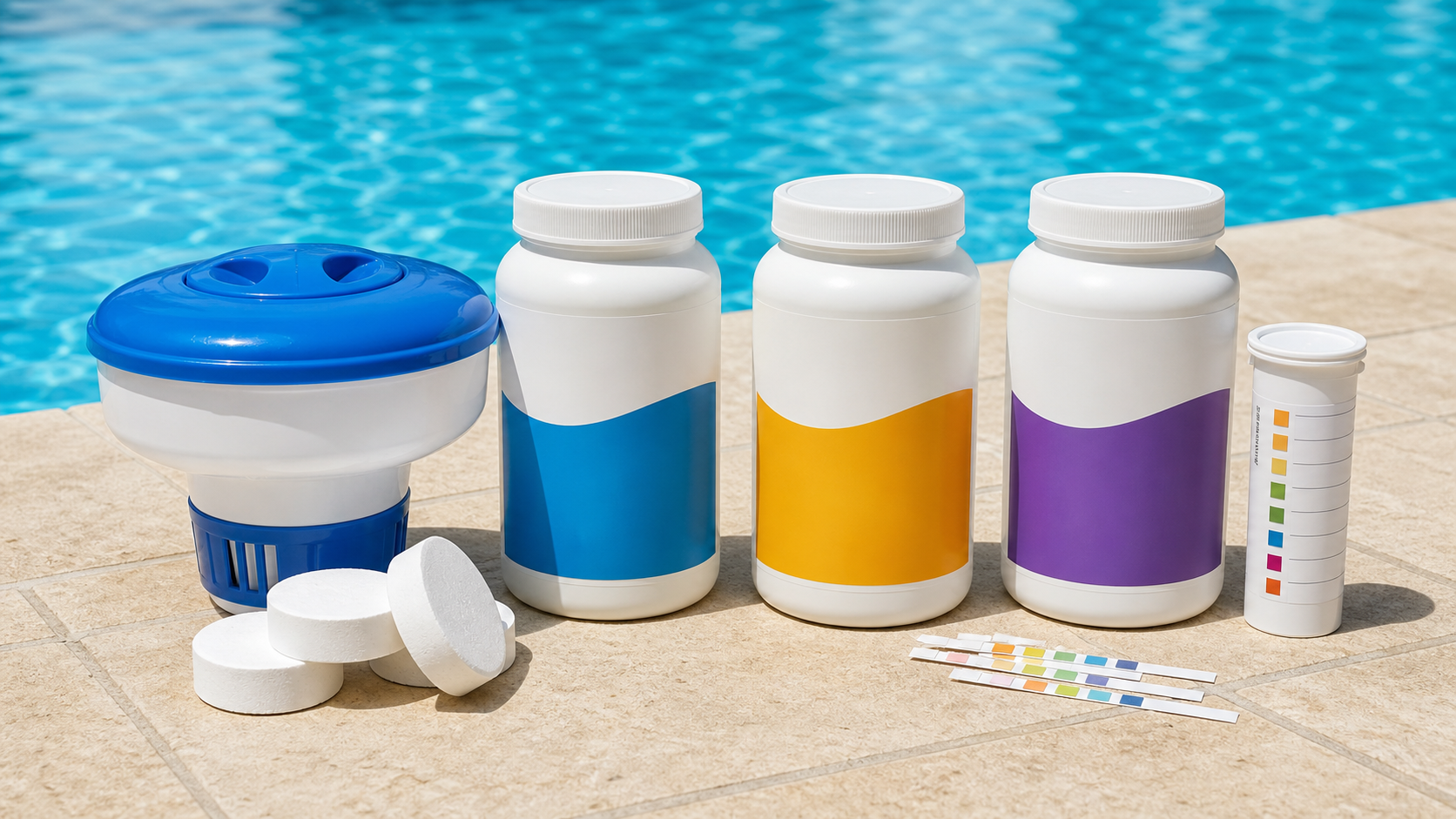
Acid lowers both numbers, and aeration then raises pH while alkalinity stays where the acid left it. Each round of acid plus air leaves alkalinity a little lower and pH roughly where it started.
Start by testing both numbers and writing them down. With the pump running, pour muriatic acid slowly in front of a return at the deep end so the flow carries it around the pool. Where you pour makes no difference to how much alkalinity comes out; a given amount of acid removes the same alkalinity whether it goes in one spot or across the whole surface. As a rough guide, 12 to 16 fluid ounces of 31.45% acid per 10,000 gallons drops pH about 0.2 when alkalinity is near 100.
Bring pH down to about 7.0 to 7.2 and stop there. Water below 7.0 starts etching plaster and corroding metal.
Then aerate. Point the returns up so they break the surface, run a water feature or the spa jets, or set an air pump in the water. Aeration drives carbon dioxide out, and pH climbs back toward 7.4 to 7.6 while alkalinity stays down.
Retest, write the numbers down again, and repeat the cycle until alkalinity reads 80 to 120.
Take a 20,000 gallon pool reading alkalinity 160 and pH 8.0 through its first round. Getting pH to 7.2 is a 0.8 drop, four steps of 0.2, so the rough guide says 96 to 128 ounces for that many gallons. Alkalinity at 160 resists more than at 100, so pour about 100 ounces, a little over three quarters of a gallon, run the pump for an hour and test pH before adding the rest. Test alkalinity after each aeration round, and the size of the drop tells you how many more rounds to plan.
How long it takes
Plan on several days. A pool starting near 200 can take a week of cycles, and each aeration round can take twelve to twenty four hours to bring pH back.
Rushing it with big acid doses drops pH below 7.0, and water that acidic eats into the plaster surface.
Handling acid safely
Wear goggles and chemical-resistant gloves, and pour low and slow at the surface so nothing splashes back. If you prefer to pre-dilute, fill a plastic bucket with pool water first and add the acid to the water. Never mix acid and chlorine, and keep the jug sealed and stored outside the garage, because the fumes rust tools and anything metal nearby. Dry acid (sodium bisulfate) does the same job in granule form and is easier to store; dissolve it in a bucket of pool water before it goes in.
If alkalinity creeps back up
Hard fill water carries its own alkalinity, so topping off a pool that loses an inch or two a week to evaporation adds some back every week. New plaster pushes both pH and alkalinity up through its first year, and salt pools drift upward as the cell runs. Check the labels on anything you add as well, since soda ash and some shock products raise both numbers. Testing every week while you correct it shows which of these is feeding it.
Alkalinity and hardness are separate problems
Alkalinity and calcium hardness are different tests, and acid only moves alkalinity. Hardness comes down by draining part of the pool and refilling with softer water, which we cover in calcium hardness in pool water.
Let us run the numbers
Bring about a pint of water from elbow depth to our supply store on Navarro within the hour, along with your pool’s gallons. We will read alkalinity, pH and hardness together and tell you how much acid to start with and roughly how many cycles yours will need.
Frequently Asked Questions
What lowers alkalinity in a pool?
Muriatic acid or dry acid, the same products that lower pH. Aeration between doses is what lets you lower alkalinity while bringing pH back up.
How do I lower alkalinity without lowering pH?
Add acid with the pump running to bring pH down to about 7.0 to 7.2, then aerate the water. Aeration pushes pH back up toward 7.4 while alkalinity stays where it fell. Repeat until alkalinity is in range.
How long does it take to lower pool alkalinity?
Several days for most pools, and up to a week if alkalinity is near 200. Each aeration round takes twelve to twenty four hours on its own.
What should pool alkalinity be?
Between 80 and 120 parts per million for a plaster pool, and often 60 to 80 for a salt pool. Above that range it drags pH up and causes scale, and below it pH swings after every small change.
Will baking soda lower alkalinity?
Baking soda raises alkalinity. It is what you add when alkalinity reads too low, so keep it away from a pool that already reads high.
Is high alkalinity bad for a pool?
It keeps pH climbing, which slows chlorine, and it leaves scale on tile and equipment. Bringing it down to 80 to 120 makes every other number easier to hold.
How long after adding muriatic acid can I swim?
Give it about an hour with the pump running so the acid mixes through, then test. Once pH reads 7.2 or higher, swimming is fine. Keep swimmers out while pH sits below that during a lowering cycle, because water that acidic stings eyes.
